

What’s Happening to America? Part 3: Liberal Elitism & the Power of Perception

When the Democratic Party hand-selected their candidate for president in the 2024 election, they all but assured that Donald Trump would regain the White House. Why? Liberal elitism.
As I outlined in the first part of this What’s Happening to the United States series, the Democrats walked right into the Republican narrative that paints them as an elite class of latte-sipping, book-reading, policy-wielding intellectuals who believe they know what’s best for the world (to paraphrase). By removing voter input in the nomination process, they reinforced that perception.
But is it a reality? Are liberals truly wealthy, out-of-touch snobs? What does it even mean to be an elitist in modern America?
The Basics of Liberal Elitism
Consider this statement:
"The people who claim to support the interests of the working class are themselves members of the ruling class and are therefore out of touch with the real needs of the people they claim to support."
That is the core critique of liberal elitism. It suggests that education, wealth, and cultural preferences have created an elite class that governs in the name of the working class while remaining disconnected from it. Democrats have helped fuel this perception, and Republicans have masterfully weaponized it.
In 2008, Barack Obama was labeled an elitist after his remarks about small-town Americans "clinging to guns or religion."
In 2016, Hillary Clinton dismissed half of Donald Trump’s supporters as a "basket of deplorables."
In 2004, Democratic candidate Howard Dean was mocked as a "latte-drinking, sushi-eating, Volvo-driving, New York Times–reading, body-piercing, Hollywood-loving, left-wing freak show."
These moments, just to name a few, were amplified by conservative media to reinforce the idea that Democrats are out of touch with the everyday concerns of blue-collar and rural Americans. But is there any truth to this accusation?
Elitism in Academia
Education level is one of the central pillars in how Americans view the concept of elitism. It’s a clear signifier of elitism for voters, but how is that revealed in the data? As we discovered in part one of this series, there’s a clear connection between education level and voter preference.
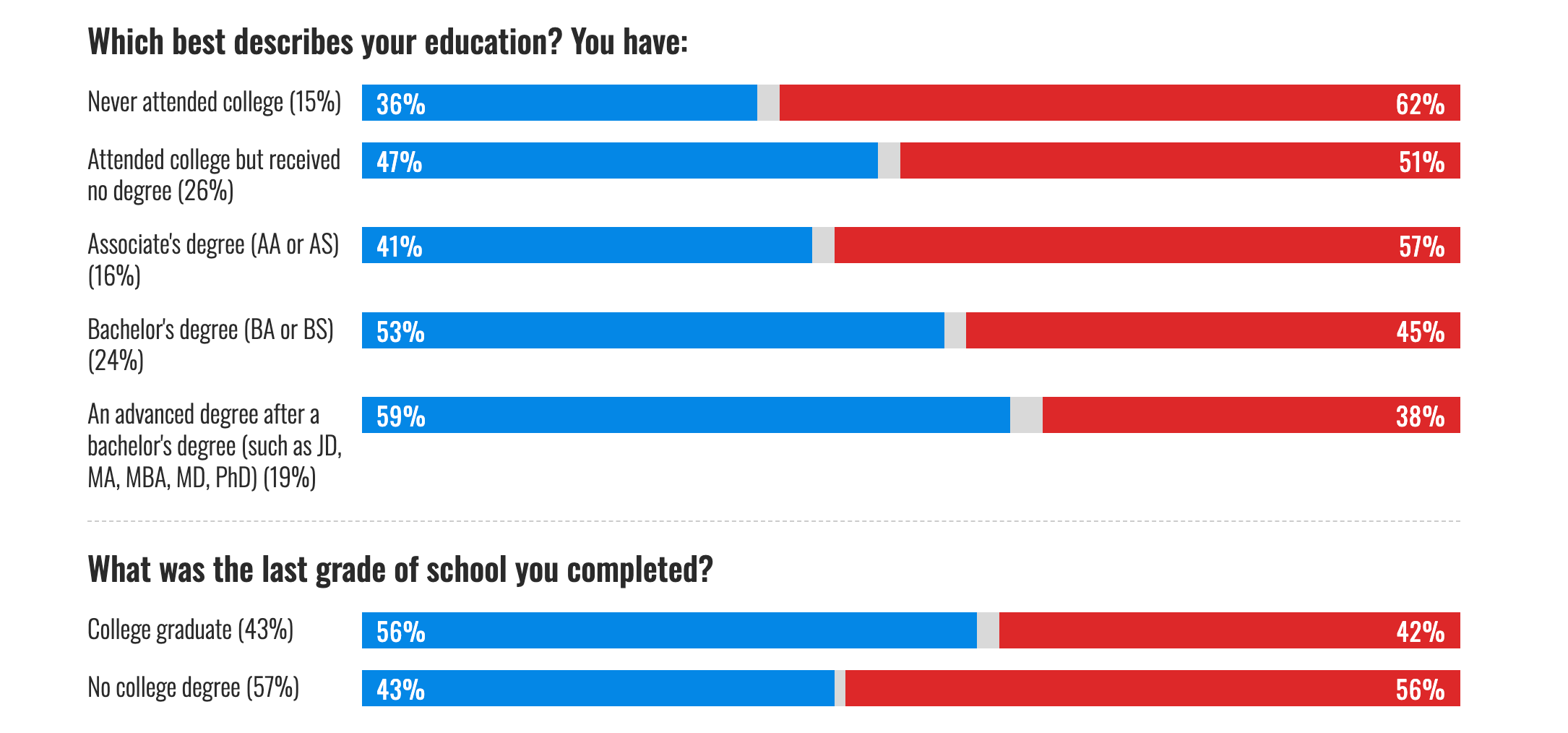
College-educated voters increasingly support Democrats, while Republicans have become the party of the non-college-educated. This distinction helps drive the perception that Democrats are the party of the academic elite. Who pushes that perception and benefits from it, though? Republicans do. And those political class Republicans are as academically elite as the Democrats. When you take the concept of educational elitism and view it through the lens of those making the laws, the Democrat-Republican divide vanishes because elites reside in both parties:
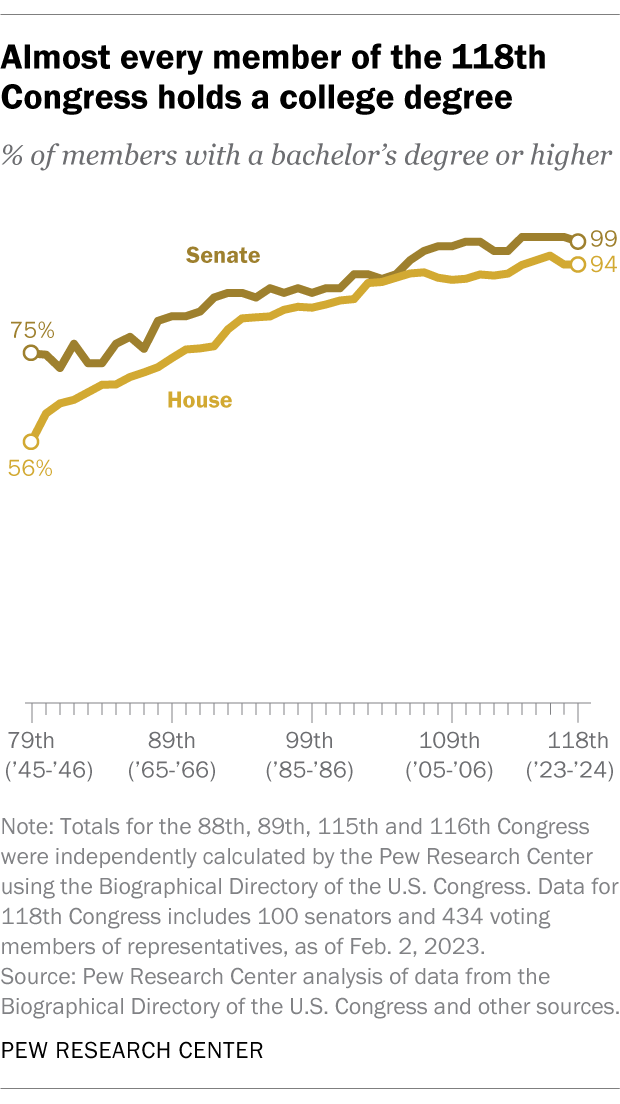
As of 2023, 94% of House members and all but one U.S. Senator held at least a bachelor’s degree.
In the 117th Congress (2021-2023), about 10% of Senators and 6% of Representatives had undergraduate degrees from Ivy League institutions, despite Ivy League schools educating less than 1% of U.S. undergraduates.
How does this trend carry over to the executive branch?
In the Oval Office, you have to go back to Jimmy Carter to find a Democratic president who didn't attend an Ivy League school (and he went to the U.S. Naval Academy). On the Republican side, George H.W. Bush and George W. Bush both attended Ivies, as did current President Donald Trump and Vice President J.D. Vance. So, when we look at education levels within the political class, both parties are filled with Ivy League alumni and college graduates.
While the populace skews to the left as education levels increase, this is not true for those in power. Both parties seek higher degrees, and many attend some of the country’s most prestigious colleges and universities.
Elitism in Culture
Beyond education, cultural preferences have become a battleground for defining elitism. The "cultural elite" are often associated with cosmopolitan preferences like art, literature, food, and media connected to urban, educated lifestyles. This divide is stark in the U.S.:
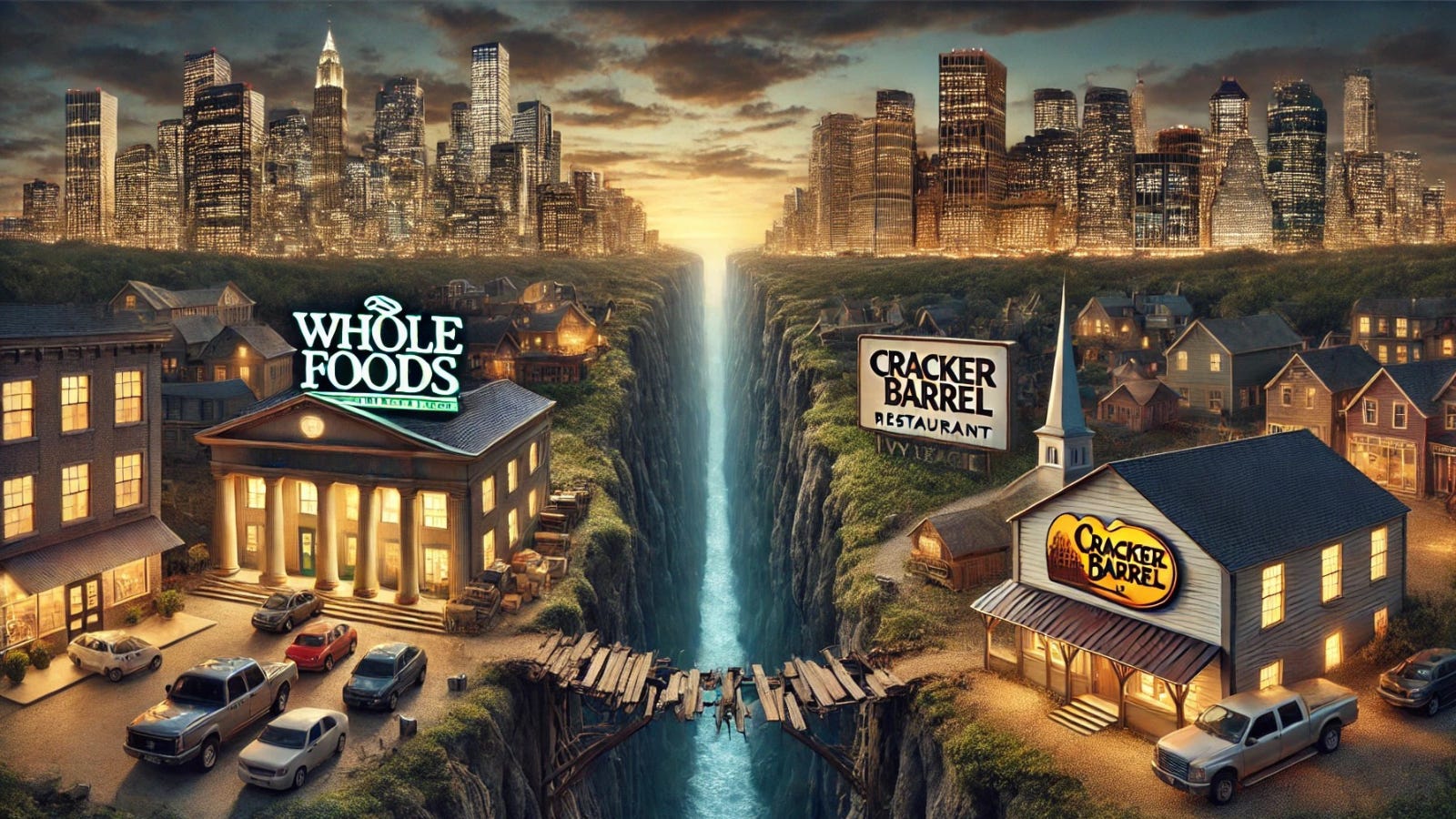
In the 2016 election, Donald Trump won 76% of counties with a Cracker Barrel restaurant but only 22% of counties with a Whole Foods Market. Whole Foods is typically found in affluent, highly educated areas, while Cracker Barrel thrives in more rural, traditional communities.
The term "latte liberal" became a stereotype for urban elites with sophisticated tastes, while conservatives embraced “working-class authenticity” through things like NASCAR, country music, and religious traditions.
A 2015 sociological study confirmed that musical preferences align with wealth and education. Higher-income individuals preferred classical music and opera, while country music and heavy metal were more common among the working class.
This cultural divide fuels resentment. Republicans often rail against “Coastal Elites,” accusing them of being disconnected from real America. Meanwhile, Democrats have been dismissive of "Duck Dynasty culture," "Walmart voters," or "gun-toting Bible thumpers." Both sides have leaned into these stereotypes, widening the cultural chasm and helping lead to a decay of decency.
The bottom line is humans are tribalistic. As Seth Godin says, “People like us do things like this.” We want our actions to help identify us as members of a larger group. Whether your grocery store selection makes you elite or not can’t be proven by data, but in the court of public opinion, the Republicans have succeeded in connecting with average Americans by making these types of arguments.
We live in a world where someone who prefers carbonated water can be seen as a hifalutin erudite who looks down on people through a glass of Perrier. This means choosing the existence of concentrated gas inside the liquid you’re drinking can be viewed as a social indicator. Is this fair? That’s not for me to decide, but what I will say it’s a truthful analysis of the world we live in.
Elitism in Wealth
Of all the elitist markers, though, economic elitism is the most tangible and iconic, especially in the pridefully capitalistic United States of America. For the wealthy liberal elites, it’s also rooted in history.
Consider the label of “limousine liberal” that emerged in the 1960s to describe wealthy progressives as advocating for the poor while remaining insulated from economic hardships in the comfort of their own limousines. This term has been used to describe “Hollywood elites,” “Silicon Valley elites,” “East Coast elites,” and more. But interesting enough, while they’re most often associated with liberals, you can find just as many conservatives who fit this mold. J.D. Vance, for example, is both a graduate of an elite East Coast university and a former member of the Silicon Valley class. Donald Trump lives in a gilded tower and an exclusive resort when he’s not in the White House.
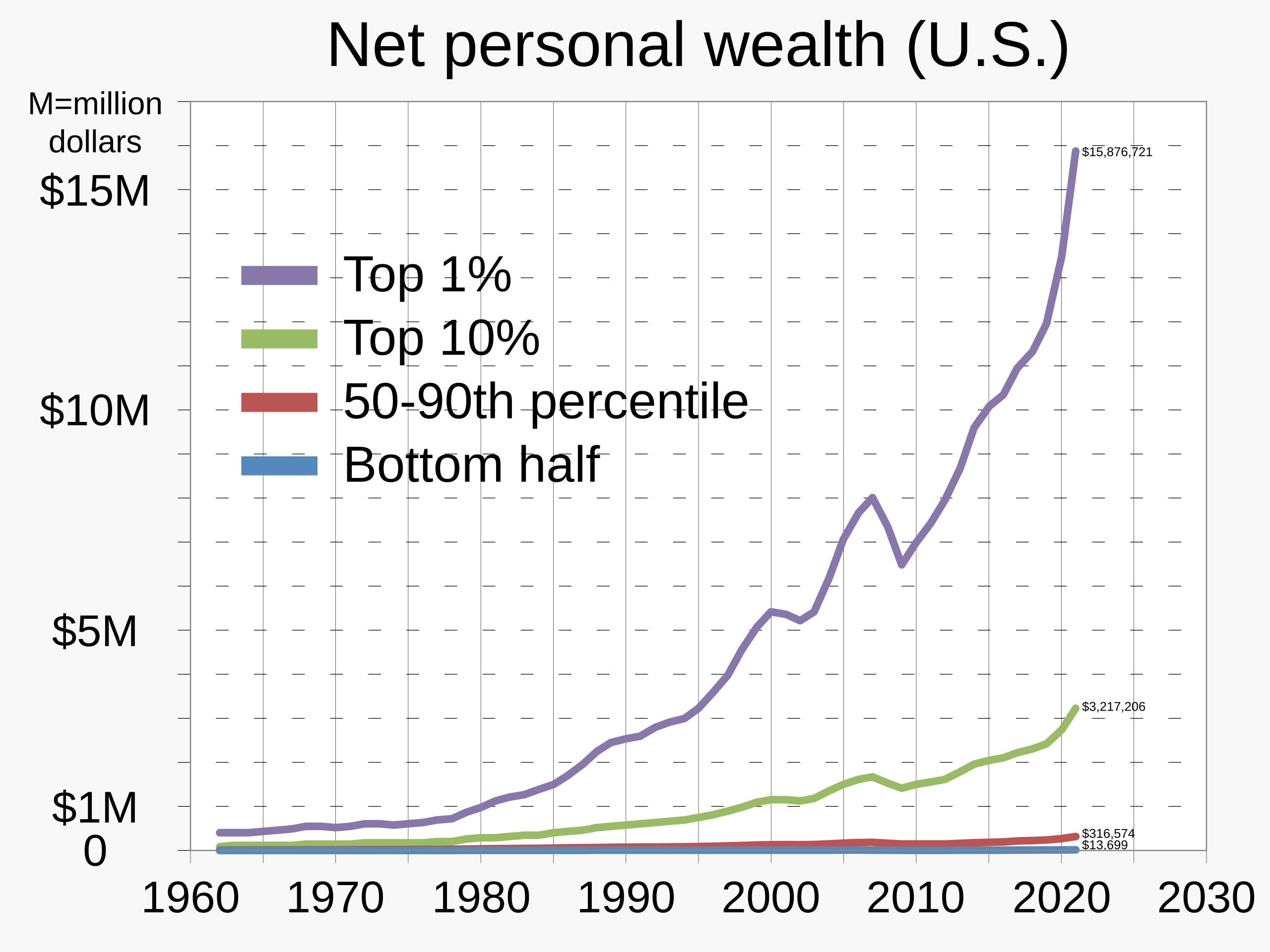
Terms like “limousine liberal” and “East Coast elites” aim to harness the power of narrative. They leverage the storylines buried within today’s unprecedented wealth inequality, where the richest percentages of Americans own all the wealth:
So, going back to wealthy liberals in limousines or conservative real estate moguls in the Oval Office… Can they or do they even want to solve the challenges caused by income inequality? Do they not benefit from it? What are their motivations for holding political power?
These are all questions for another time, but what’s clear is that Americans—of both political persuasions—overwhelmingly claim that the ultra-wealthy have too much influence in American politics. Yet, the idea of ultra-wealthy people with enormous influence is exactly what we have:
All of this said, we need to ask the question—who comprises the economic elites? Is it the liberal class that shops at Whole Foods, or is there another facet of economic elitism at play?
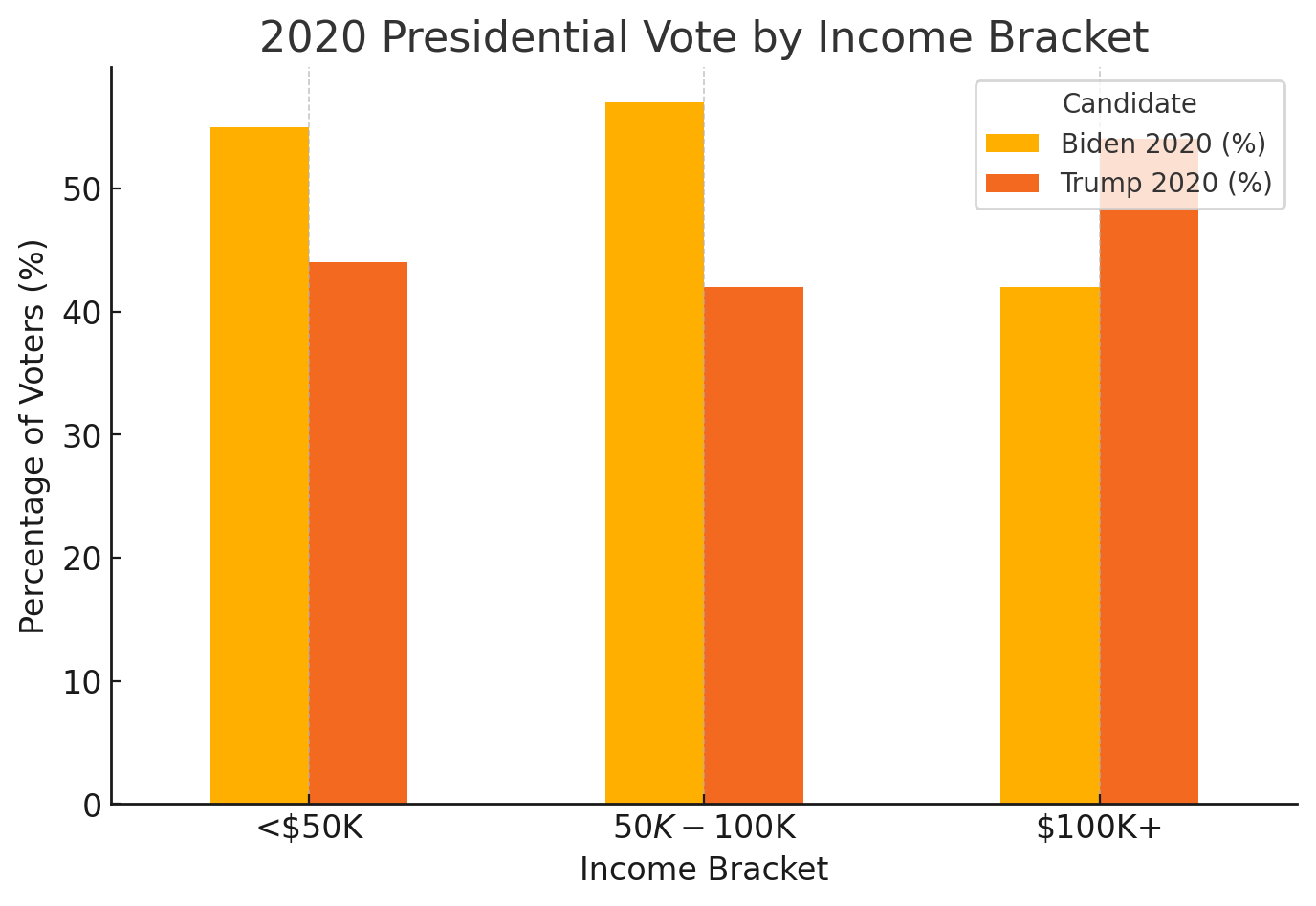
In 2020, Biden won voters making under $50,000 by significant margins, while Trump won voters making over $100,000.
At the same time, consider this:
Counties that voted for Biden in 2020 accounted for 70% of U.S. economic output, while Trump-supporting counties made up just 29%.
So what does that mean?
On an individual level, Republicans win the wealthiest voters. But geographically, Democrats dominate the richest areas in the country—New York, California, Massachusetts, and major urban hubs. This contradiction fuels the debate:
Republicans claim to represent working-class America but still cater to wealthy business interests, while Democrats claim to fight for the poor but are concentrated in wealthy, educated urban centers. What gives?
Conclusion: The Reality of Liberal Elitism
So, are Democrats the true elitists? The answer is: yes… and no.
The perception that Democrats are the party of the elite is largely rooted in education and cultural preferences. Their voter base is increasingly college-educated, concentrated in wealthier urban areas, and aligned with institutions of power—academia, media, and tech. This makes them an easy target for Republicans, who have successfully framed them as out-of-touch, self-righteous intellectuals detached from blue-collar concerns.
But the reality is more complicated. Wealth and political power are just as present—if not more so—on the Republican side. GOP leaders rally against liberal elites while pushing tax cuts that disproportionately benefit wealthier citizens. At the same time, whether elected or confirmed to a government position or not, some of those wealthy citizens are being invited to directly influence public policy. And even within the Oval Office, a billionaire real estate mogul successfully positioned himself as a champion of the working class when he’s probably never worked a day of manual labor in his life.
The contradiction exists on both sides:
Democrats attract highly educated professionals but also retain a significant non-white working-class base.
Republicans cater to non-college voters but still win the wealthiest individuals and corporate donors.
In the end, both parties are deeply embedded in elite circles, but Democrats have taken (or been branded as) the cultural mantle of elitism—a perception that could just as easily be applied to the GOP leadership, which maintains deep ties to corporate power and wealth while branding itself as champions of the common man.
The better question isn’t whether Democrats are elitists. It’s why Republicans have been so much better at convincing America that they aren’t.